AQL Sampling Plans for Export Manufacturing: Applying Statistical Methods to Final Product Verification
Export manufacturing is a tricky balancing act. Once a product is completed, companies must ensure that it conforms to the required specifications, but it is not possible, feasible or cost-effective to inspect each individual product. This is even more difficult if the number of produced units is thousands or millions.
When a large production batch is involved, statistical sampling offers a practical means of assessing the batch without having to inspect each product. Sampling plans, if designed properly, enable the quality team to determine if the defect rate is unacceptable, to ensure shipment consistency, and to help them decide if the shipment is ready for release.
Understanding AQL Sampling in Manufacturing
The Acceptable Quality Limit (AQL) is a statistical term that helps define sampling and acceptance criteria for inspection. It gives a systematic method to determine the number of units to be checked from a production lot and the number of defects that can be detected without discarding the lot.
In export operations, the principles of sampling are generally applied for Pre-shipment inspection of finished goods before leaving the manufacturing unit. It’s not about whether each individual unit is perfect. Rather, the sampling process gives statistical evidence of the quality of the whole batch, based on a known inspection plan.
How an AQL Sampling Plan Works
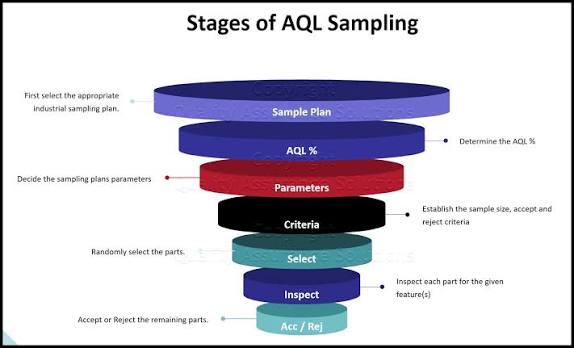
The first step in an AQL plan is to determine the size of the production lot. The inspection team then decides on the number of samples required for the sampling standard and level of inspection. The plan also establishes acceptance/rejection numbers for various defect categories.
This is especially helpful when there are varying degrees of defects. A defect that is critical may have a much more stringent acceptance criterion than a defect of minor cosmetic nature. This separation enables quality teams to handle all defects as if they were not of equal severity, and enables the decision on whether to inspect to be based on the actual risk of the product.
Key Elements of an Effective Sampling Plan
A good sampling system requires more than just a number of samples. There are a number of technical parameters that will influence whether the inspection will yield useful and consistent results.
- Lot Size: It is the number of people or items that make up the sample.
- Inspection Level: Indicates the proportion of inspection needed.
- Sample Size: Defines the number of units that will be tested.
- AQL Value: Represents the chosen quality level of the inspection plan.
- Defect Classification: Classifies critical, major and minor defects based on impact.
- Acceptance Number: Specifies how many defects can be found before the lot fails.
- Rejection Number: The number that specifies when the production lot is rejected.
- Sampling Method: Decides how to select the units to eliminate unnecessary bias.
These should be agreed prior to inspection. Otherwise, the inspector could make decisions that vary from one inspection to the next, or the inspector might pick a product that is not an accurate representation of the production lot.
Why Random Sampling Matters
Random selection is an important part of statistical inspection. Inspectors may only pick products from the most accessible cartons or from the top of a pallet, which may not be representative of the whole shipment. It is possible that defects that were missed in other production batches or packaging locations could be found.
A good random sample provides an equal chance to be sampled to all eligible units. Sampled cartons, pallets, production batches or individual units can be selected from various locations using predefined sampling instructions by inspectors. This enhances the coverage of the inspection and helps to minimise selection bias.
Defect Classification and Acceptance Decisions
Another crucial part of AQL based inspection is the classification of defects. Typically, findings are categorized as Critical findings, Major findings, and Minor findings, with the specific definitions varying based on the product and inspection needs.
Defects can be critical and may present serious safety or regulatory issues and therefore need to be addressed immediately. Significant defects may impact product functionality, performance, or the ease of use for the customer. Minor defects can have a limited effect but can still impact on appearance and/or customer perception. These categories are set out before the inspection, to ensure consistency in decisions.
Limitations of Statistical Sampling
The power of sampling is great, but it does not ensure that all the defective units will be found. A sample is a part of a production lot and defects not found in the sample may be present in the entire lot. That’s one of the reasons it’s important to use sampling in conjunction with good manufacturing controls and process monitoring.
Product risk must be taken into account in sampling plans as well. The approach to a safety critical component may be different to a simple consumer product. In the case of high-risk products, a business may need further testing, stricter acceptance criteria, 100% inspection of certain characteristics or specific functional testing.
Using Data to Improve Future Production
AQL results can offer other useful information besides the shipment decision. The companies can monitor defect patterns at the supplier level, the factory level, the production batch level and the product category level. This data can provide information about manufacturing issues over time.
If packaging damage occurs frequently, for instance, it could be a sign of problems with packing processes or in preparation for transport. If there are recurring dimensional defects, this may indicate an equipment calibration problem or a process-control problem. This use of inspection data makes individual inspection reports a more comprehensive quality improvement tool.
Conclusion
Using statistical sampling provides a systematic way for export manufacturers to assess large production runs without having to inspect each item. With suitable sample size, defect category, acceptance criteria and sampling methods, the method can be used to enhance consistency and reduce the amount of inspection work.
Finally, if Product Inspection is to be effective it will be much more effective if it is backed by a well-defined statistical methodology. A well designed AQL plan does not supersede manufacturing quality systems, it provides an additional layer of verification to aid businesses in making more consistent shipment decisions, to identify recurring defects and to ensure that customer protection is extended throughout global markets.